Turbocharger
A turbocharger is a forced induction device fitted to an internal combustion engine that compresses incoming air before it enters the intake manifold, allowing more air — and therefore more fuel — to be burned for a given engine displacement. Unlike a supercharger, which is driven mechanically from the crankshaft, a turbocharger derives its power from the kinetic energy of the engine's exhaust gases. The device was historically called a turbosupercharger and was classified as a type of supercharger until the mid-twentieth century.
The concept was first patented in 1905 by Swiss engineer Alfred Büchi, working at Sulzer, in a patent describing a compound radial engine with an exhaust-driven axial-flow turbine and compressor on a common shaft — an arrangement that remains the basis of turbocharger design to this day.
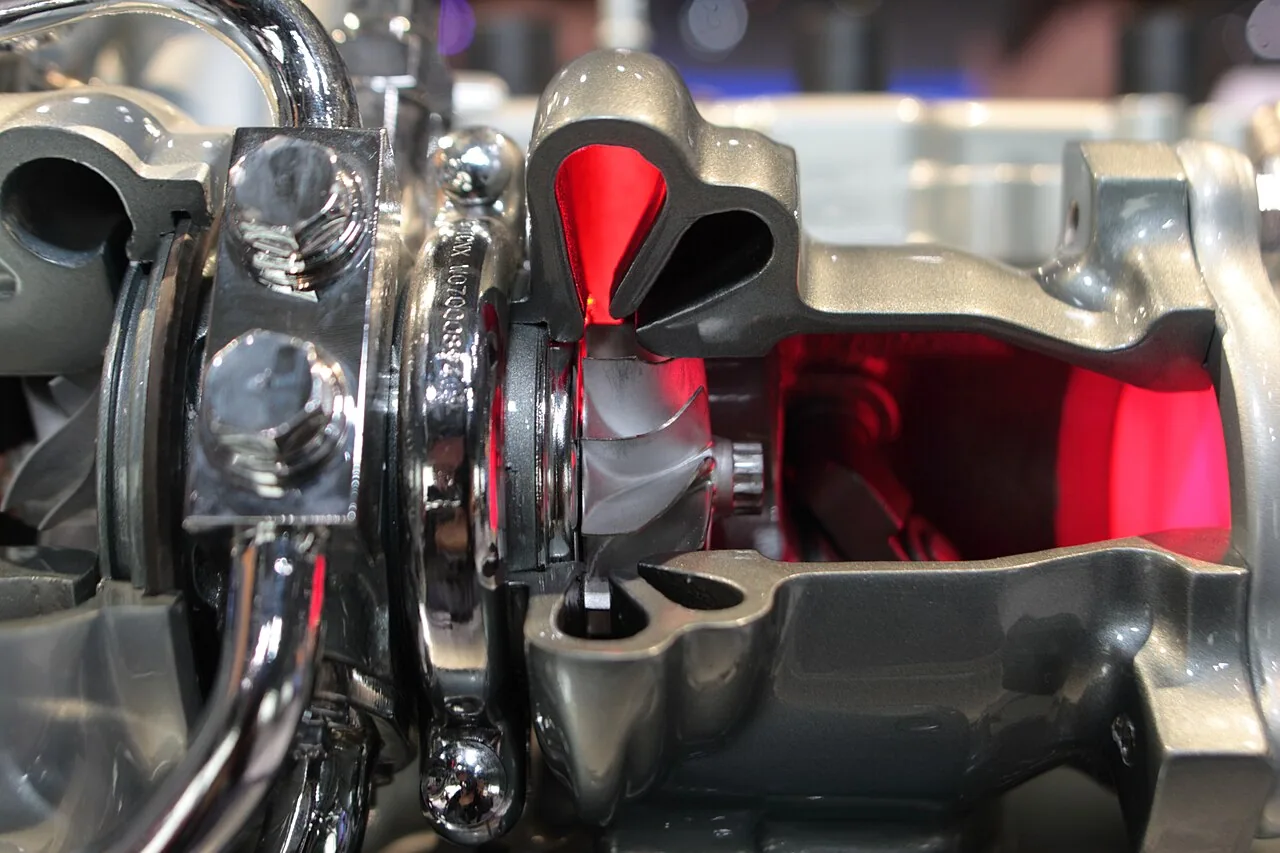
| Type | Forced induction device (exhaust-driven) |
| Also known as | Turbo; formerly turbosupercharger |
| Founding patent | Alfred Büchi, Sulzer, 1905 |
| First commercial unit delivered | June 1924, Brown Boveri & Cie model VT402 |
| First turbocharged production cars | Chevrolet Corvair Monza and Oldsmobile Jetfire, both 1962 |
| First major motorsport win | 1968 Indianapolis 500 |
| First Formula One World Championship | 1983, BMW M10-based four-cylinder engine |
| Turbodiesel passenger car milestone | Mercedes 300 D, 1970s |
| Key distinguishing feature vs supercharger | Powered by exhaust gas energy, not by a belt from the crankshaft |
| Main components | Turbine, centrifugal compressor, center housing hub rotating assembly |
Who invented the turbocharger?
Before the turbocharger existed, forced induction was achieved exclusively by mechanically driven superchargers. Scottish engineer Dugald Clerk built the first supercharged two-stroke gas engines to his own design in 1878, and in 1885 Gottlieb Daimler patented the use of a gear-driven pump to force air into an internal combustion engine.
The 1905 patent filed by Alfred Büchi, a Swiss engineer employed at Sulzer, is widely regarded as the birth of the turbocharger. His patent described a compound radial engine in which an exhaust-driven axial-flow turbine and a compressor were mounted on a single common shaft. French steam turbine inventor Auguste Rateau filed a separate turbocharger patent in 1916, specifically for use on Renault engines powering French fighter aircraft.
Early development and aviation applications
Büchi's first prototype was completed in 1915, with the goal of counteracting the power loss that aircraft engines suffered at high altitudes due to reduced air density. The prototype proved unreliable and did not enter production.
Independent testing carried out in 1917 by the National Advisory Committee for Aeronautics (NACA) and Sanford Alexander Moss, using the Liberty L-12 aircraft engine at Pikes Peak in the United States, demonstrated that a turbocharger could allow an engine to maintain its sea-level power output at altitudes of up to 4,250 metres (13,944 ft). During the Second World War, turbochargers were fitted to several American aircraft, beginning with the Boeing B-17 Flying Fortress in 1938, whose units were manufactured by General Electric. The Consolidated B-24 Liberator, Lockheed P-38 Lightning, Republic P-47 Thunderbolt, and experimental versions of the Focke-Wulf Fw 190 were among other aircraft to adopt the technology.
First commercial and industrial use
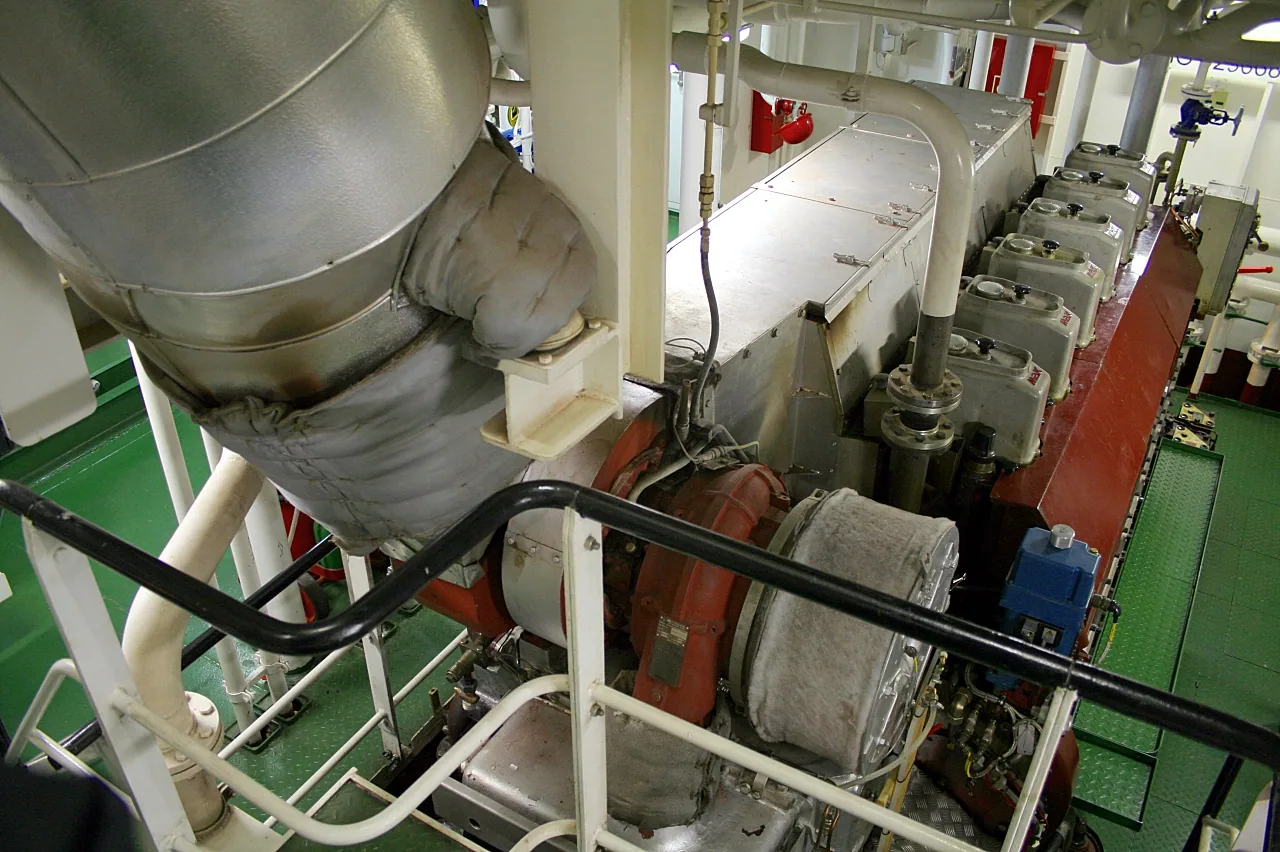
The first commercial turbocharger was the model VT402, delivered in June 1924 from the Baden works of Brown, Boveri & Cie — under Alfred Büchi's supervision — to SLM, the Swiss Locomotive and Machine Works in Winterthur. The following year, in 1925, Büchi successfully applied turbochargers to ten-cylinder diesel engines, raising their power output from 1,300 to 1,860 kilowatts (1,750 to 2,500 hp). The German Ministry of Transport employed these engines in two large passenger ships, the Preussen and the Hansestadt Danzig.
Swiss truck manufacturer Saurer brought the technology to road freight during the 1930s, producing its BXD and BZD engines with optional turbocharging from 1931 onward. Switzerland's role in pioneering turbocharging during this period was substantial, with Sulzer, Saurer, and Brown, Boveri & Cie all contributing to its development. Büchi's engine design was licensed to several manufacturers, and turbochargers were progressively adopted for marine, rail-car, and large stationary power applications.
When did turbocharged cars reach production?
Automobile manufacturers began researching turbocharged engines during the 1950s, but two obstacles blocked early progress: turbo lag — the delay in power delivery caused by the time required for the turbocharger to reach its peak rotational speed — and the considerable physical size of the units available at the time. Neither problem was resolved satisfactorily in that decade.
The first turbocharged production cars appeared in 1962: the Chevrolet Corvair Monza and the Oldsmobile Jetfire. Both were short-lived. Turbodiesel passenger cars entered the global market in the 1970s, with the Mercedes 300 D representing a significant milestone. Broader adoption of turbocharging in petrol-engined passenger cars followed in the 1980s, primarily as a means of extracting greater performance from smaller-displacement engines.
Turbochargers in motorsport
The turbocharger found early competitive success in circuit racing. The 1968 Indianapolis 500 was the first large-scale race recorded as won by a turbocharged engine, and turbocharged cars continued to dominate that circuit in subsequent years. Porsche was an early adopter in production-based motorsport: the air-cooled flat-six engine derived from the 1963 Porsche 911 was turbocharged in 1973, and in 1976 the Porsche 935 and Porsche 936 won both categories of the Sportscar World Championship as well as the 24 Hours of Le Mans, demonstrating the reliability of turbocharged competition machinery.
Formula One turbocharger victories began in the late 1970s, where the technology proved especially effective at generating high power outputs from small-displacement engines. The first Formula One Constructors' and Drivers' World Championship won using a turbocharged engine came in 1983, powered by an engine derived from the BMW M10 four-cylinder block, a design that itself dated back to 1961.
How does a turbocharger work?
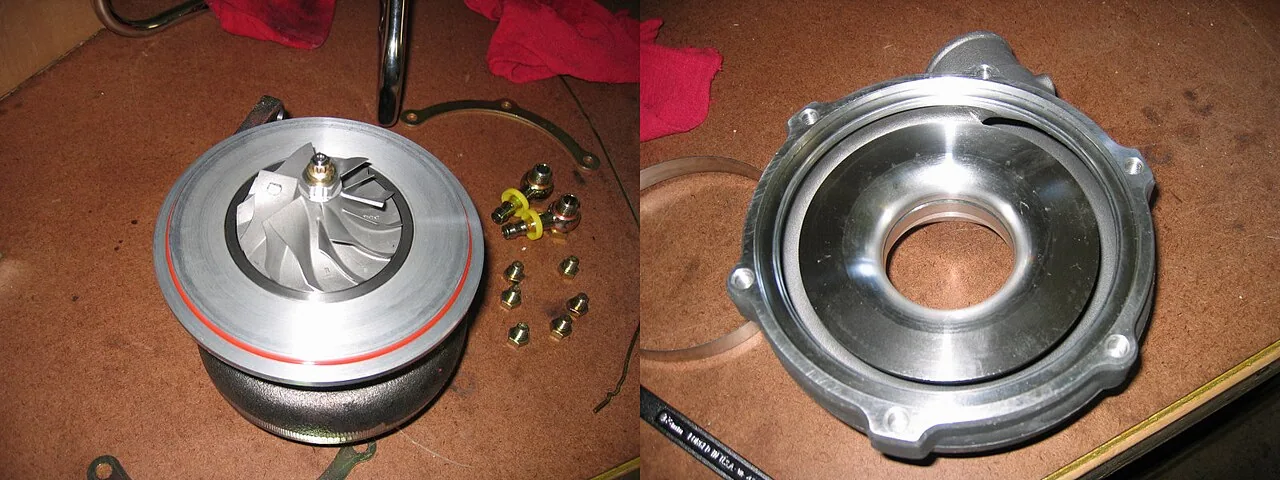
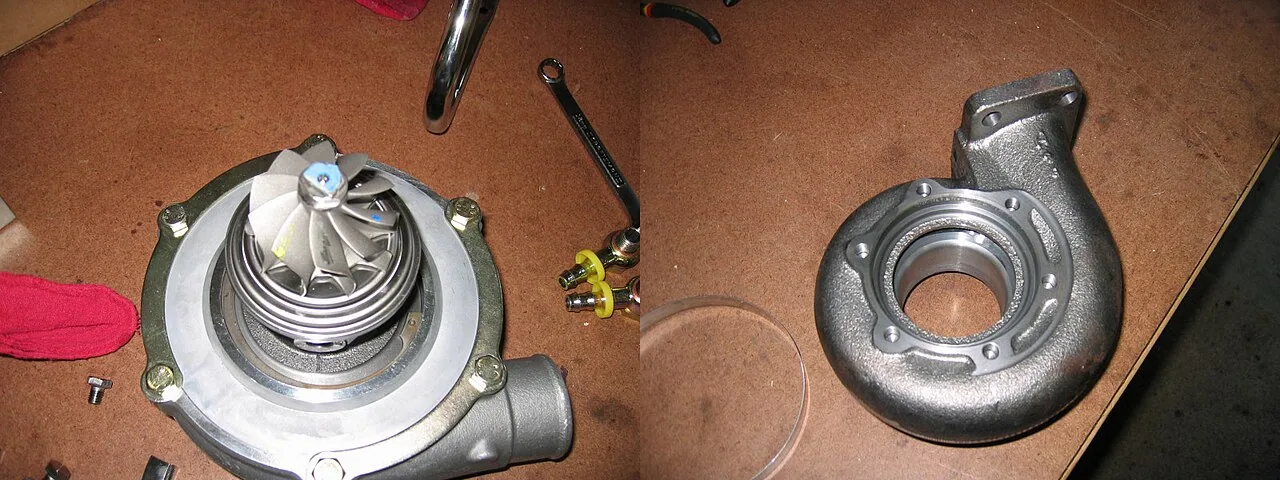
A turbocharger consists of three principal assemblies: a turbine, a centrifugal compressor, and the center housing hub rotating assembly that connects and supports them. Exhaust gases leaving the engine pass through the turbine section — sometimes called the hot side or exhaust side — where a series of blades converts the kinetic energy of the gas flow into the rotational mechanical energy of a shaft. This shaft drives the compressor on the opposite end of the unit.
The compressor pressurises the intake air before it reaches the inlet manifold, forcing a greater mass of air into the engine's cylinders than atmospheric pressure alone would supply. The turbine in most automotive applications uses a radial design, while the compressor is typically of the centrifugal type. After the exhaust gases have transferred their energy to the turbine, they continue through the exhaust system and exit the vehicle in the normal way.
Turbocharger vs. supercharger
Both turbochargers and superchargers are forced induction devices that compress intake air to raise engine power, but their energy sources differ fundamentally. A supercharger is driven mechanically, most commonly by a belt connected to the engine's crankshaft, meaning it consumes a portion of the engine's own output. A turbocharger, by contrast, is driven entirely by the energy present in the exhaust gas stream, energy that would otherwise be lost through the exhaust.
The distinction was not always drawn clearly: until the mid-twentieth century, the turbocharger was referred to as the turbosupercharger and was categorised as a subset of the supercharger family. The two device types are now treated as separate technologies.
Frequently asked questions
What is a turbocharger and how does it differ from a supercharger?
A turbocharger is a forced induction device that compresses an engine's intake air using a turbine driven by exhaust gas energy, thereby increasing power output for a given displacement. A supercharger achieves the same compression goal but is powered mechanically, usually via a belt from the crankshaft. Until roughly the mid-twentieth century, the turbocharger was called a turbosupercharger and was classified as a type of supercharger.
Who invented the turbocharger and when?
The 1905 patent by Alfred Büchi, a Swiss engineer at Sulzer, is generally considered the origin of the turbocharger. His patent covered a compound radial engine with an exhaust-driven axial-flow turbine and compressor sharing a common shaft. Büchi also oversaw the delivery of the first commercial unit, the model VT402, in June 1924.
What were the first turbocharged production cars?
The first turbocharged production automobiles were the Chevrolet Corvair Monza and the Oldsmobile Jetfire, both introduced in 1962. Neither model had a long production run. Wider adoption of turbocharged passenger cars came in the 1980s, when manufacturers used the technology to boost performance from smaller engines.
When did turbochargers first win in Formula One?
Turbocharged engines recorded their first Formula One race victories in the late 1970s, benefiting from their ability to produce high power from small displacements. The technology went on to win the Formula One World Championship in 1983, with an engine built around the BMW M10 four-cylinder block, a design originating in 1961.
What is turbo lag?
Turbo lag is the delay between a driver demanding more power and the turbocharger delivering it, caused by the time needed for the turbine to accelerate to its operating speed. This phenomenon was identified as a significant engineering problem when automobile manufacturers began researching turbocharging in the 1950s. Inability to resolve turbo lag satisfactorily at that time was one reason production turbocharged cars did not appear until 1962.
What was the first major motorsport event won by a turbocharged engine?
The 1968 Indianapolis 500 is recorded as the first large-scale race won by a turbocharged engine. Turbocharged cars then went on to dominate the Indianapolis circuit in subsequent years. Porsche's turbocharged entries, the 935 and 936, won both Sportscar World Championship categories and the 24 Hours of Le Mans in 1976.
What are the main components of a turbocharger?
A turbocharger comprises three main assemblies: the turbine, which extracts kinetic energy from the exhaust gases; the centrifugal compressor, which pressurises the intake air; and the center housing hub rotating assembly, which supports and connects the two. The turbine is usually a radial design and is located on the exhaust side, while the compressor sits on the intake side of the unit.
When were turbochargers first used in trucks and ships?
Swiss truck manufacturer Saurer introduced optional turbocharging on its BXD and BZD engines from 1931, representing the first practical truck application. For marine use, Alfred Büchi's turbocharged ten-cylinder diesel engines, delivering up to 1,860 kilowatts (2,500 hp), were installed in two German passenger ships, the Preussen and the Hansestadt Danzig, following successful tests completed in 1925.
Sources
- Wikipedia: Turbocharger — Factual basis of this entry