Ford Mustang
The Ford Mustang is an American automobile manufactured and marketed by Ford since 1964. Currently in its seventh generation, it holds the distinction of being Ford's longest-running nameplate in continuous production and ranks as the fifth-best-selling Ford car nameplate. Its pronounced long-hood, short-deck proportions defined a new class of vehicle — the pony car — combining sporty styling with components drawn from existing model lines.
Introduced on April 17, 1964, at the New York World's Fair, the Mustang surpassed all initial projections: Ford had anticipated annual sales of 100,000 units, yet more than 400,000 were sold in the first year alone, making it the most successful vehicle launch since the 1927 Model A. The one-millionth example left showrooms within two years of introduction, and by August 2018 Ford had produced its ten-millionth Mustang — a 2019 Wimbledon White V8 convertible deliberately chosen to mirror the original 1965 car.
| Manufacturer | Ford Motor Company |
| Country of origin | United States |
| Production start | March 9, 1964 (Dearborn, Michigan) |
| Current generation | Seventh |
| Segment created | Pony car |
| First-year sales | Over 400,000 units |
| One-millionth unit | Within two years of April 1964 launch |
| Ten-millionth unit | August 2018 (2019 model-year Wimbledon White V8 convertible) |
| Drive layout | Rear-wheel drive throughout all generations |
| Ford nameplate rank | Fifth-best-selling Ford car nameplate |
Who originated the Mustang name?
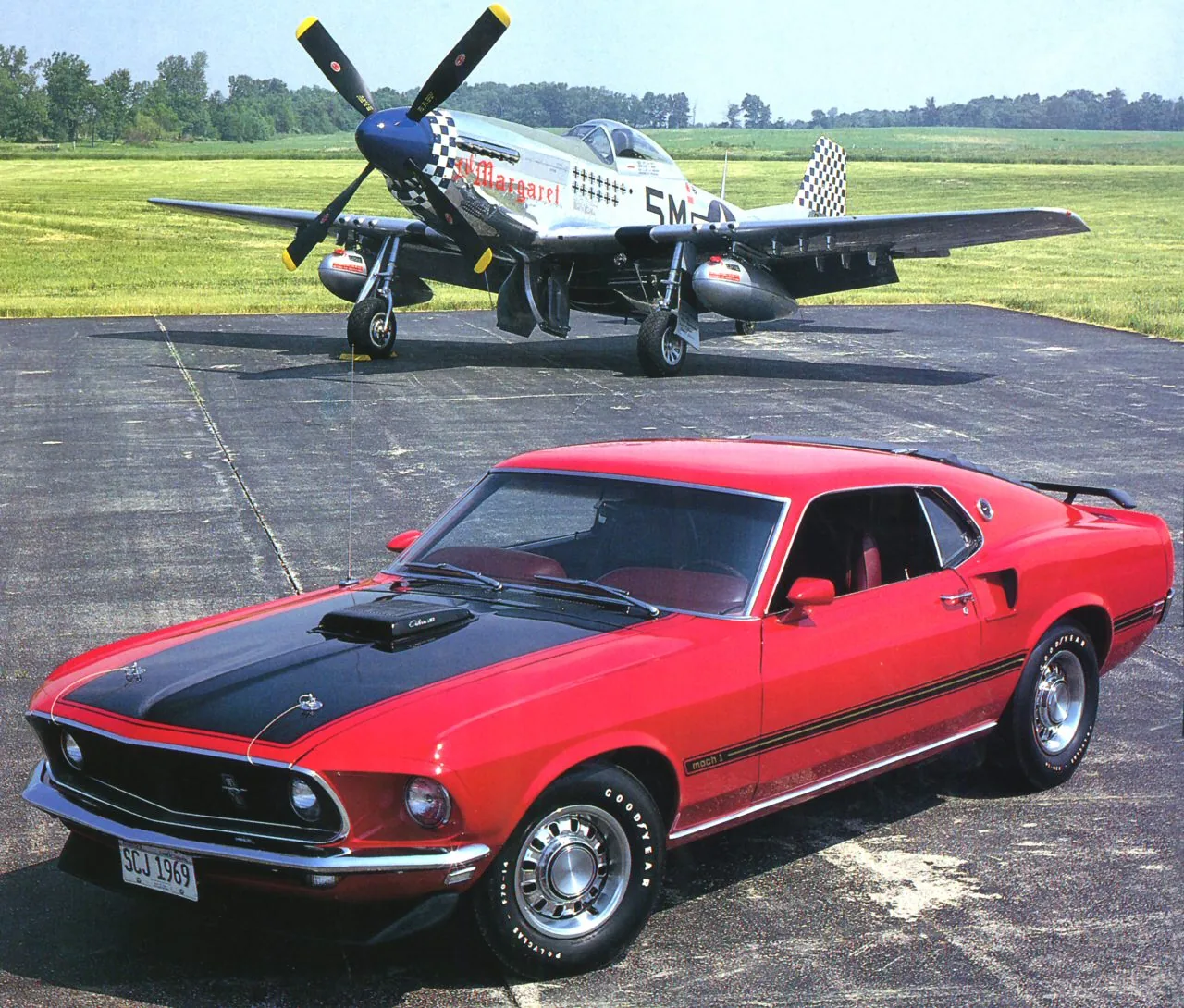
Two accounts compete for credit over the name. Ford's official attribution goes to executive stylist John Najjar, a fan of the World War II P-51 Mustang fighter aircraft. Najjar co-designed the first prototype — the Ford Mustang I — in 1961, working alongside fellow Ford stylist Philip T. Clark.
An alternative account credits Robert J. Eggert, Ford Division market research manager and quarter-horse breeder, whose wife gave him J. Frank Dobie's book The Mustangs as a birthday gift in 1960. As the person responsible for evaluating candidate names, Eggert added 'Mustang' to the focus-group list; it finished first by a wide margin under the criterion 'Suitability as Name for the Special Car'. Other names seriously considered included Cougar — visible on early styling bucks — and Torino, for which an advertising campaign was actually prepared; Henry Ford II had favoured T-bird II.
The name posed a legal obstacle in Germany, where Krupp held the Mustang trademark for trucks it manufactured between 1951 and 1964. Ford declined to purchase the rights from Krupp for approximately US$10,000. The moped maker Kreidler also used the name in that market, so German-market cars were badged T-5 until December 1978.
Genesis: from concept to production
The process that became the production Mustang began with the Ford Mustang I, a two-seat mid-engine roadster concept powered by the German Ford Taunus V4 engine. This prototype made its formal public debut on October 7, 1962, at the United States Grand Prix at Watkins Glen, New York, where Formula One driver Dan Gurney demonstrated the second race prototype on the circuit.
By 1963, the two-seat concept had evolved into the Mustang II four-seater show car, which Ford used to gauge public reaction before committing to production. The Mustang II shared front and rear styling cues with what would become the production model but carried a roofline 2.7 inches (69 mm) lower. The production car was grounded in the platform of the second-generation North American Ford Falcon compact, and Gale Halderman's side-view design formed the basis of the first clay model.
Lee Iacocca, then Ford Division general manager, championed the programme. His assistant general manager and chief engineer, Donald N. Frey, led the engineering work and guided the car from concept to production in a record 18 months under the internal designation T-5.
When and how was the Mustang first sold?
Assembly began at Dearborn, Michigan, on March 9, 1964 — five months before the formal start of the 1965 model year. The first retail sale occurred on April 14, 1964, at a Ford dealership in St. John's, Newfoundland, Canada, three days before the official public launch. That official introduction took place on April 17, 1964, at the New York World's Fair, sixteen days after the Plymouth Barracuda had reached market.
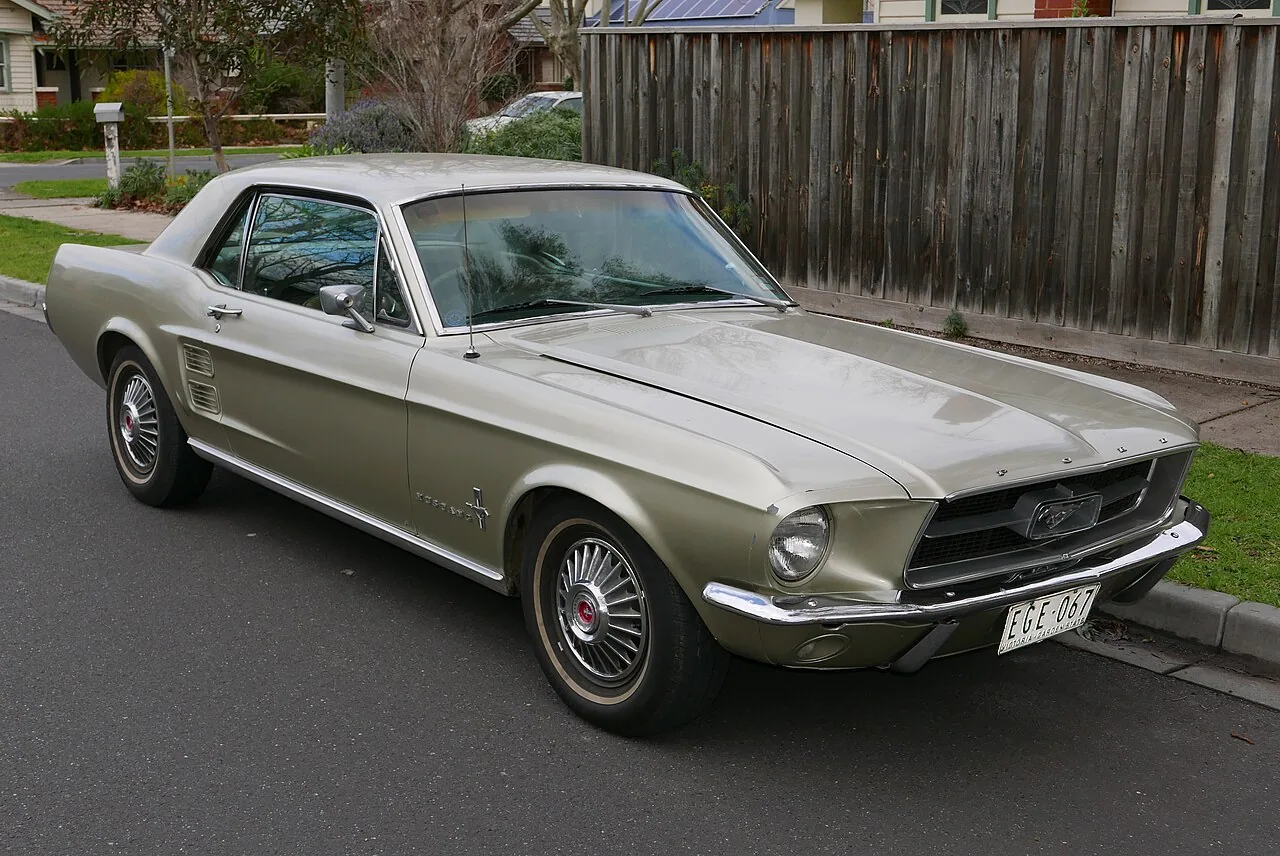
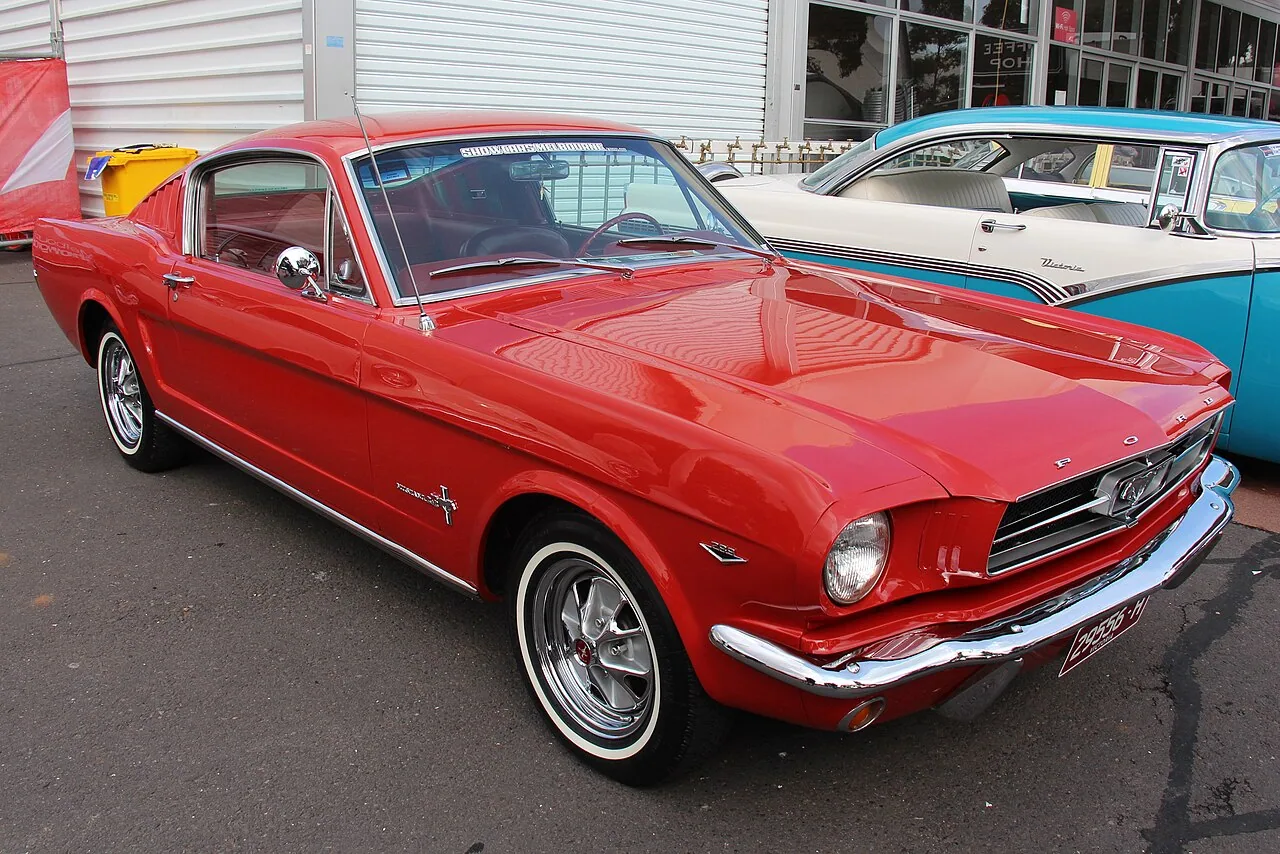
Because production began so early in the cycle, early cars are commonly referred to as '1964½ models', though Ford advertised, VIN-coded, and titled every example as a 1965 model. Minor design changes implemented in August 1964 at the true start of the 1965 production year mean that early-production data is often tracked separately from the rest of the 1965 run. At launch, body styles comprised a two-door hardtop and a convertible; a '2+2' fastback variant joined the range in September 1964.
Platform and chassis history across generations
From 1965 through 2004, every Mustang shared its chassis architecture with other Ford model lines, yet remained rear-wheel drive throughout. The first generation, covering 1965 to 1973, was derived from the 1960 Ford Falcon compact. When the second generation — the Mustang II — arrived for 1974, it was based on a lengthened version of the Ford Pinto platform, a configuration that continued through 1978.
The 1979 model year brought the Fox platform, which the Mustang shared with fourteen other Ford vehicles over a production run lasting until 2004, by which point the Mustang was the last remaining Ford product still using that architecture. Beginning with the 2005 model year, the Mustang moved to the D2C platform, developed exclusively for the Mustang and not shared with other Ford lines.
Notable nameplates and badging
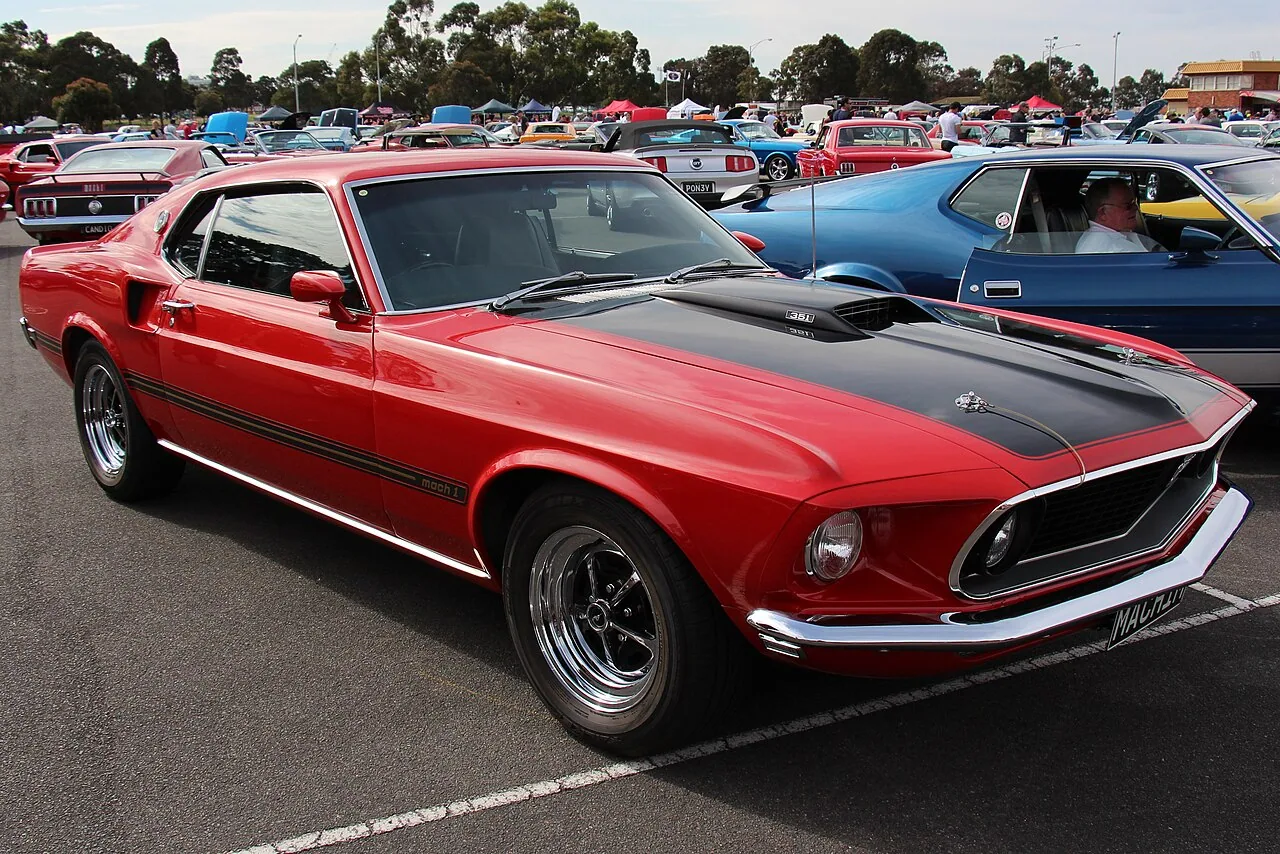
Several performance and special-edition nameplates have appeared across Mustang generations. These include the GT, Mach 1, Boss 302, Boss 429, Cobra — distinct from the Shelby Cobra — and Bullitt. The '5.0' fender badge has also been used at various points, denoting either a 4.9-litre overhead-valve V8 or a 5.0-litre DOHC V8 depending on the period.
Competitive impact and market context
The Mustang's commercial success prompted direct responses from rival American manufacturers. General Motors introduced the Chevrolet Camaro and Pontiac Firebird in 1967, AMC countered with the Javelin in 1968, and Dodge launched the Challenger in 1970. The Plymouth Barracuda, which preceded the Mustang to market by sixteen days in April 1964, was its earliest direct competitor.
The Mustang's influence extended beyond the United States. Its styling contributed to the global marketing of the Toyota Celica and, via Lincoln-Mercury, the Ford Capri in the American market. Within Ford's own range, the Mercury Cougar launched in 1967 as a distinct-bodied, higher-trim alternative to the Mustang; during the 1970s, it was repositioned as a personal luxury car with an expanded feature set.
Production milestones
The Mustang's first-year performance exceeded forecasts by a factor of four: internal projections had anticipated 100,000 annual sales, yet over 400,000 units were delivered in the first twelve months. The one-millionth Mustang was sold within two years of the April 1964 launch.
The ten-millionth Mustang was produced in August 2018. Ford deliberately specified that car as a 2019-model-year Wimbledon White convertible with a V8 engine, mirroring the specification of the original 1965 model to mark the occasion.
Frequently asked questions
When was the Ford Mustang first introduced to the public?
The Mustang was officially introduced on April 17, 1964, at the New York World's Fair. However, the first retail sale had already taken place on April 14, 1964, at a dealership in St. John's, Newfoundland, Canada, and production had begun at Dearborn, Michigan, as early as March 9, 1964.
How many Mustangs were sold in the first year?
More than 400,000 Mustangs were sold in the first year of production. This was far above the original forecast of 100,000 annual units and made the launch the most successful since the 1927 Ford Model A. The one-millionth unit was sold within two years of the April 1964 introduction.
Why were Mustangs sold under a different name in Germany?
The Mustang name was owned in Germany by Krupp, which had produced trucks under that name between 1951 and 1964. Ford declined to purchase the trademark from Krupp for approximately US$10,000. Additionally, the moped manufacturer Kreidler used the name in that market, so German-market Mustangs were sold as T-5s until December 1978.
What platforms has the Ford Mustang used across its generations?
From 1965 to 1973 the Mustang was based on the 1960 Ford Falcon compact platform. The Mustang II (1974–1978) used a lengthened Ford Pinto platform. From 1979 to 2004 the car rode on the Fox platform, shared with fourteen other Ford vehicles. Since 2005 the Mustang has used the D2C platform, which is exclusive to the model.
What car did the Mustang name originate from?
Ford officially credits executive stylist John Najjar, an admirer of the World War II P-51 Mustang fighter aircraft, with proposing the name. An alternative account attributes it to market research manager Robert J. Eggert, who added 'Mustang' to a focus-group list of candidate names after the subject was inspired by J. Frank Dobie's book The Mustangs; it placed first among the options tested.
Which competitors did the Mustang's success inspire?
The Mustang's strong sales directly prompted the Chevrolet Camaro and Pontiac Firebird (both 1967), the AMC Javelin (1968), and the Dodge Challenger (1970). The Plymouth Barracuda, which actually reached market sixteen days before the Mustang in April 1964, was its earliest rival in the same segment.
How was the ten-millionth Mustang commemorated?
Ford produced the ten-millionth Mustang in August 2018. The company chose a 2019-model-year specification — a Wimbledon White convertible with a V8 engine — to deliberately echo the appearance and configuration of the original 1965 model.
What body styles were available when the Mustang launched?
At introduction in April 1964, the Mustang was offered as a two-door hardtop and as a convertible. A third body style, the '2+2' fastback, was added to the range in September 1964. All early cars were titled and VIN-coded by Ford as 1965 models, even those built before the formal 1965 model-year start in August 1964.
Sources
- Wikipedia: Ford Mustang — Factual basis of this entry