Toyota
Toyota Motor Corporation is a Japanese multinational automotive manufacturer headquartered in Toyota City, Aichi, Japan. Founded in 1937 by Kiichiro Toyoda as a spinoff of Toyota Industries, the company has grown into the largest automobile manufacturer in the world by volume, producing approximately 10 million vehicles per year. As of 2025, Toyota holds a market capitalisation of approximately US$259.7 billion, making it one of the largest car manufacturers by that measure.
Toyota was the first automobile manufacturer in the world to exceed annual production of 10 million vehicles, a record established in 2012, the same year the company reported the manufacture of its 200 millionth vehicle. By September 2023, cumulative production had reached 300 million vehicles.
| Type | Multinational automotive manufacturer |
| Founded | August 28, 1937 (trading); company founded date celebrated November 3 |
| Founder | Kiichiro Toyoda |
| Headquarters | Toyota City, Aichi, Japan |
| Annual production | Approximately 10 million vehicles |
| Brands operated (as of 2026) | Century, Daihatsu, Lexus, Toyota |
| First production vehicle | Toyota G1 truck (1935) |
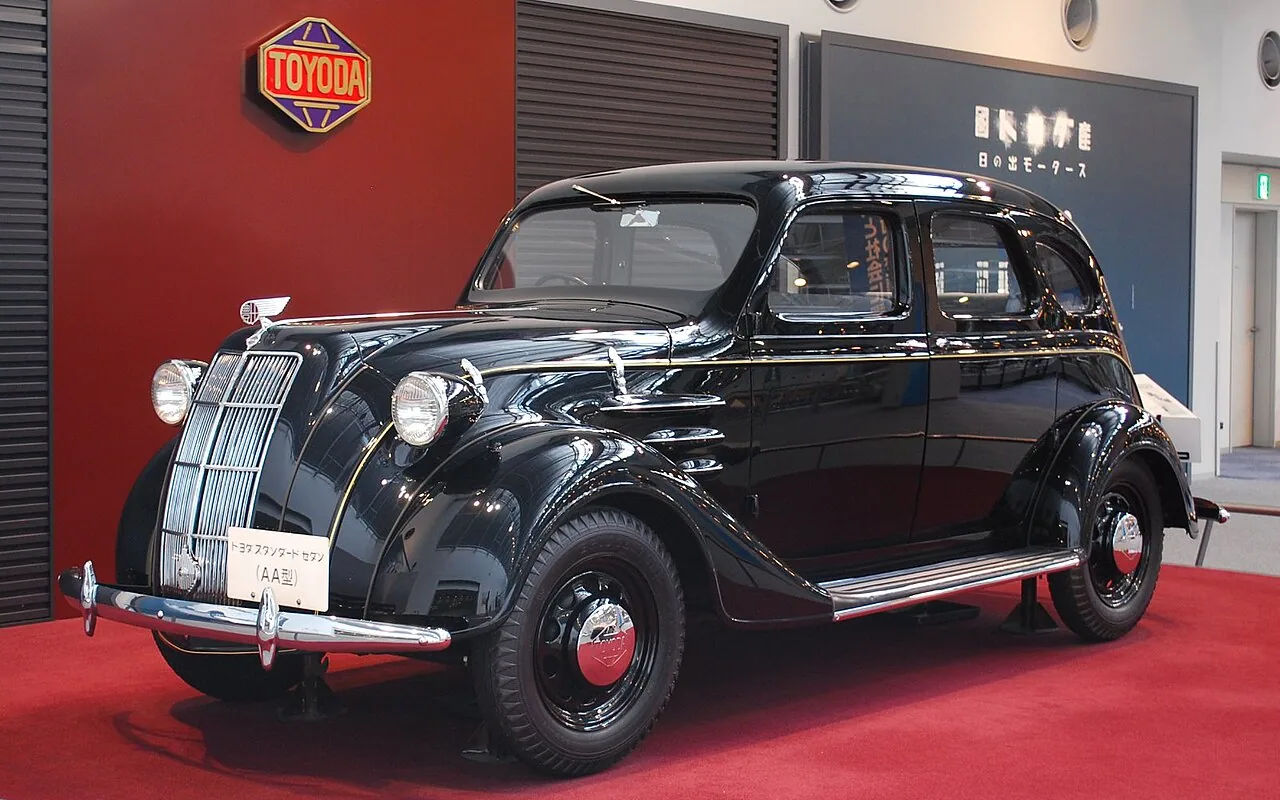
| First passenger car | Toyota Model AA (1936) |
| Stock listings | London, Nagoya, New York and Tokyo Stock Exchanges |
| Nikkei/TOPIX status | Component of Nikkei 225 and TOPIX Core30 indices |
Origins in the Toyoda loom business
Toyota's corporate lineage begins with Sakichi Toyoda, who in 1924 invented the Toyoda Model G Automatic Loom. The loom operated on the principle of jidoka — the machine halts automatically when a fault arises — a concept that would later become a foundational element of the Toyota Production System. In 1929, Sakichi sold the patent for the automatic loom to the British firm Platt Brothers, and the proceeds provided the starting capital for automobile development.
Under the direction of Kiichiro Toyoda, Sakichi's son, Toyoda Automatic Loom Works established an Automobile Division on September 1, 1933, and formally declared its intention to manufacture automobiles on January 29, 1934. The first prototype of the Toyota Type A engine was completed on September 25, 1934, followed by the company's first prototype sedan, the A1, the following May.
What was Toyota's first production vehicle?
Although the A1 prototype sedan was completed first, the Japanese government strongly prioritised truck development, so the company directed its resources toward the G1 truck. The G1 was completed on August 25, 1935, and made its public debut in Tokyo on November 21 of that year, becoming the company's first production model. Its design drew on the Ford trucks of the period; the G1 chassis was priced at ¥2,900, some ¥200 less than the comparable Ford product, and a total of 379 units were ultimately built.
Toyota's first passenger car, the Model AA, was completed in April 1936 and sold for ¥3,350, which was ¥400 less than equivalent Ford or GM vehicles. The company's manufacturing plant at Kariya was completed in May of the same year, and in July Toyota filled its first export order, shipping four G1 trucks to northeastern China. On September 19, 1936, the Japanese imperial government officially recognised Toyota Automatic Loom Works as an automotive manufacturer.
Why is the company called Toyota rather than Toyoda?
Vehicles were initially sold under the name 'Toyoda', taken directly from the founding family's surname. In September 1936 the company ran a public competition to design a new logo, receiving 27,000 entries; the winning design incorporated the three Japanese katakana characters for 'Toyoda' arranged within a circle. However, Rizaburo Toyoda — who had married into the family and did not carry the name by birth — argued for changing the spelling to 'Toyota'.
His reasoning was threefold: 'Toyota' required eight brush strokes in Japanese, regarded as a lucky number; it was visually simpler, omitting the diacritic at the end; and it used a voiceless consonant rather than a voiced one, the latter considered to carry a 'murky' quality in Japanese phonetics. Additionally, the word 'toyoda' literally translates as 'fertile rice paddies', an association the company wished to avoid. The new name was trademarked, and the Toyota Motor Company Ltd began trading under that designation on August 28, 1937.
Founding structure and early leadership
When Toyota Motor Company Ltd was formally established, Kiichiro Toyoda's brother-in-law Rizaburo Toyoda was appointed the company's first president, with Kiichiro himself serving as vice-president. Toyota Automatic Loom Works formally transferred automobile manufacturing operations to the new entity on September 29, 1937. The company's founding date is commemorated each year on November 3, chosen to coincide with the inauguration of the Koromo Plant on that date in 1938.
Growth through the mid-twentieth century and the Corolla
During the 1960s, Toyota capitalised on the rapid expansion of the Japanese economy by targeting the country's growing middle class. This period of domestic prosperity both drove demand for affordable personal vehicles and provided the financial foundation for international expansion. The same decade saw the development of the Toyota Corolla, which went on to become the best-selling automobile of all time.
International growth enabled Toyota to become not only one of the largest automakers in the world but also the largest company in Japan and, as of December 2020, the ninth-largest company in the world by revenue.
How did Toyota pioneer hybrid vehicles?
Toyota gained recognition as a leader in the development and commercialisation of hybrid electric vehicles, beginning with the launch of the original Toyota Prius in 1997. The Prius was among the first mass-produced hybrid passenger cars, and the company continued to expand this technology across its range. By the time of publication Toyota offered more than 40 hybrid vehicle models worldwide.
More recently, Toyota has faced criticism for a comparatively slow transition to fully battery-electric vehicles. Rather than prioritising that technology, the company directed significant resources toward hydrogen fuel cell vehicles, exemplified by the Toyota Mirai. Critics have noted that hydrogen fuel cell technology remains considerably more expensive and has achieved far lower commercial adoption than battery electric powertrains.
Production records and scale
Toyota became the first automobile manufacturer in the world to produce more than 10 million vehicles in a single calendar year, achieving that milestone in 2012. In that same year the company also recorded the production of its 200 millionth vehicle overall. By September 2023, cumulative global production had climbed to 300 million vehicles, underscoring the scale of output sustained over the company's history.
Brands, equity stakes and joint ventures
As of 2026, Toyota Motor Corporation produces vehicles under four brands: Century, Daihatsu, Lexus and the Toyota marque itself. Beyond its own branded output, the company holds minority equity positions in a number of other automotive businesses: a 20% stake in Subaru Corporation, a 25% stake in Archion, a 5.1% stake in Mazda, a 4.9% stake in Suzuki, a 4.6% stake in Isuzu, and a 3.8% stake in Yamaha Motor Corporation.
Toyota also participates in vehicle manufacturing joint ventures across several markets. These include two Chinese operations — FAW Toyota and GAC Toyota — as well as TPCA in the Czech Republic, Toyota Kirloskar in India, and MTMUS in the United States. Together these arrangements extend Toyota's manufacturing footprint well beyond its Japanese base.
Toyota is listed on four stock exchanges: the Tokyo Stock Exchange, where it is a component of both the Nikkei 225 and TOPIX Core30 indices, as well as the Nagoya, London and New York Stock Exchanges. Both Toyota Motor Corporation and its parent lineage remain part of the broader Toyota Group, described as one of the largest conglomerates in the world.
Frequently asked questions
When was Toyota Motor Corporation founded?
Toyota Motor Company Ltd began trading on August 28, 1937, following the formal transfer of automobile manufacturing from Toyota Automatic Loom Works. The company's official founding date is celebrated on November 3 each year, marking the inauguration of the Koromo Plant on that date in 1938.
Who founded Toyota?
Toyota was founded by Kiichiro Toyoda, the son of loom inventor Sakichi Toyoda. Kiichiro directed the establishment of the Automobile Division within Toyota Automatic Loom Works in 1933 and guided development of the company's first vehicles before the new entity was formally incorporated in 1937. The first president of Toyota Motor Company was Rizaburo Toyoda, Kiichiro's brother-in-law, with Kiichiro serving as vice-president.
Why does the company spell its name Toyota rather than Toyoda?
The name was changed from 'Toyoda' at the insistence of Rizaburo Toyoda, who argued that 'Toyota' required eight brush strokes in Japanese — regarded as a lucky number — used a clearer voiceless consonant, and was visually simpler. The word 'toyoda' also literally means 'fertile rice paddies', an association the company wished to avoid. The new name was trademarked and adopted when the company began trading in August 1937.
What was Toyota's first ever production vehicle?
Toyota's first production model was the G1 truck, completed on August 25, 1935, and publicly debuted in Tokyo on November 21 of that year. Its design was modelled on Ford trucks of the period; the chassis sold for ¥2,900, undercutting the Ford equivalent by ¥200, and a total of 379 units were produced. The company's first passenger car, the Model AA, followed in April 1936.
Which hybrid car did Toyota introduce first?
Toyota introduced the original Prius in 1997, making it one of the first mass-produced hybrid electric passenger cars. The company has continued to expand its hybrid range and by the time of publication offered more than 40 hybrid models globally. Toyota has been widely recognised as a leader in developing and selling fuel-efficient hybrid vehicles.
How many vehicles does Toyota produce each year?
Toyota produces approximately 10 million vehicles per year. It became the first automaker in the world to exceed that annual total, setting the record in 2012, the same year it reported cumulative production of 200 million vehicles. By September 2023, total production across the company's history had reached 300 million vehicles.
What brands does Toyota own or produce vehicles under?
As of 2026, Toyota Motor Corporation produces vehicles under four brands: Century, Daihatsu, Lexus and Toyota itself. In addition, the company holds minority stakes in Subaru, Archion, Mazda, Suzuki, Isuzu and Yamaha Motor Corporation, and participates in joint venture manufacturing operations in China, the Czech Republic, India and the United States.
What is Toyota's connection to the jidoka principle?
Jidoka — the concept that a machine should stop itself automatically when a fault occurs — originated with Sakichi Toyoda's 1924 Toyoda Model G Automatic Loom. The principle was later incorporated as a core element of the Toyota Production System, the manufacturing philosophy that underpins Toyota's production operations. It reflects a broader commitment to building quality checks directly into the production process rather than relying solely on inspection after the fact.
Sources
- Wikipedia: Toyota — Factual basis of this entry